
RF Situational Awareness
Continuously monitor the RF environment and alert operators when mission-defined conditions occur.
Radio Intelligence Agent (RIA)
Real-Time RF Agentic Intelligence
Traditional RF analysis systems require experts to configure sensors, interpret the data outputs, and determine follow-on analysis and other next steps. Running these legacy systems involves highly manual processes, which are compounded by the underlying siloed tools and workflows.
RIA provides a new class of RF analysis and workflow-automation capabilities. End users describe their goals using nontechnical, natural-language requests. RIA’s agents then determine how to configure the RF sensors, which edge models to run, how to analyze the resulting information, and how to combine current and historical RF observations to answer the user’s question and recommend next steps that can be automated.
RIA combines edge sensing, agentic orchestration, and persistent RF memory for operations that demand speed, context, and adaptability.
Continuously monitor the RF environment and alert operators when mission-defined conditions occur.
Process voice or data signals and make the extracted content available for live and historical analysis.
Establish an RF baseline and identify changes, anomalies, or previously observed activity.
Turn distributed sensor observations into mission-focused summaries without manually consolidating data from multiple RF tools.
The operator defines the outcome. RIA handles the RF configuration, edge model selection, analysis workflow, and delivery of the answer.
Ask a question, define an alert, request a report, or establish an ongoing monitoring objective in natural language.
Agents translate intent into RF sensor tasking, model selection, processing workflows, and historical data queries.
NVIDIA-accelerated sensors execute RF and AI models at the edge, close to where the signals are collected.
RIA combines live observations with historical context to provide answers, alerts, reports, and supporting evidence.
Your sensor network currently has four active devices. Here is the current configuration:
RIA combines an intelligent RF sensor network, an agentic pipeline with persistent memory, and an interactive mission interface.
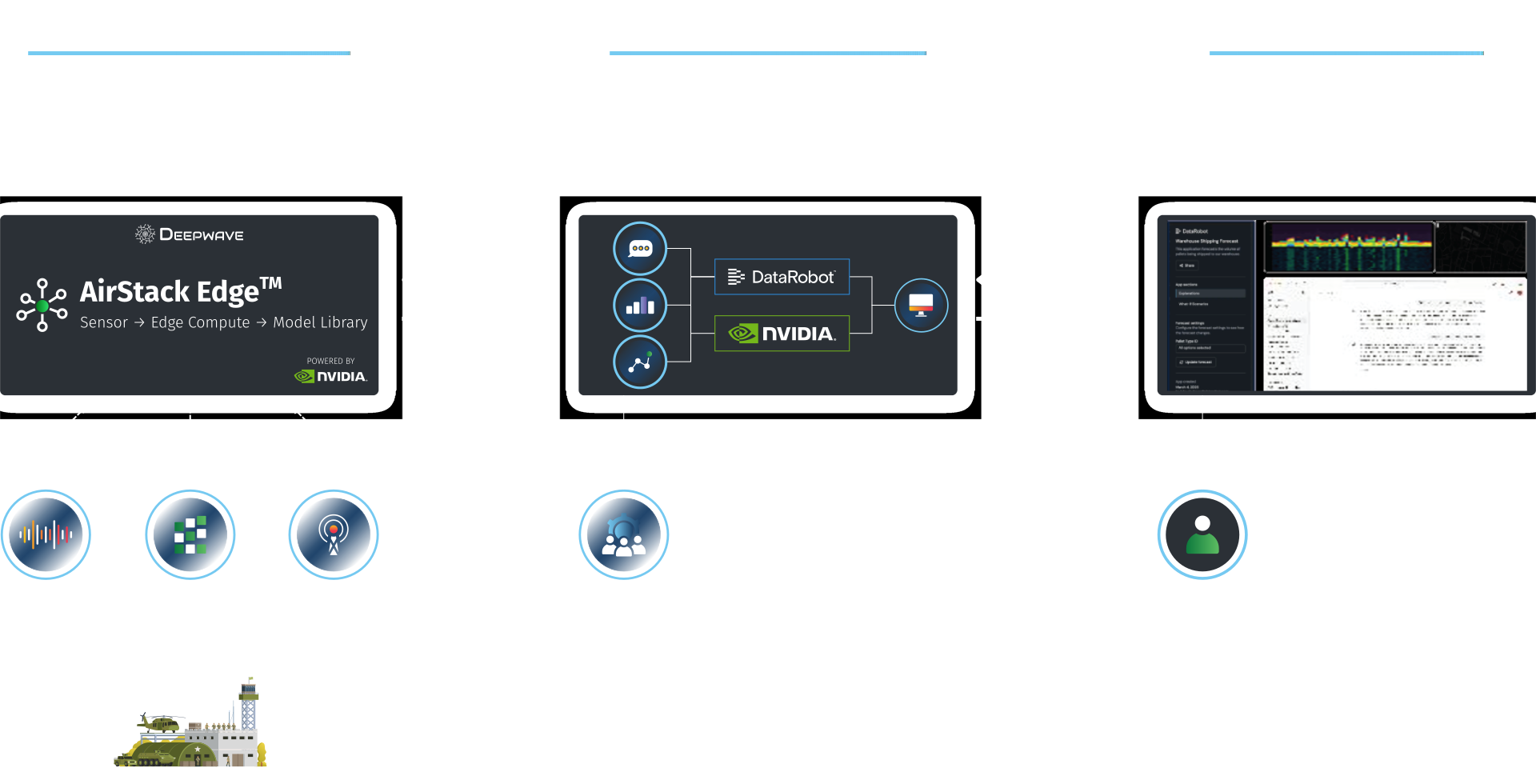
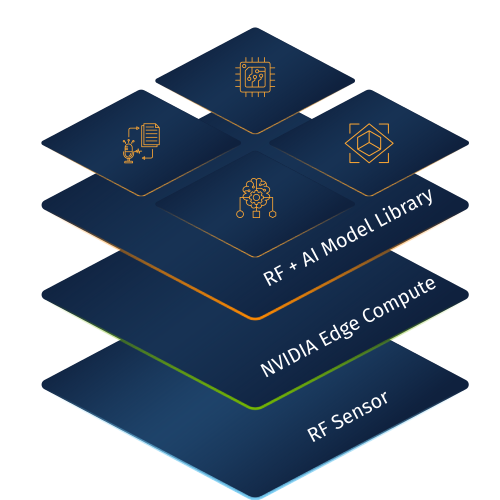
RIA sensors combine software-defined RF hardware with NVIDIA edge computing, allowing signal-processing and AI workloads to execute directly at the sensor.
RIA stores RF observations and derived intelligence as a persistent, searchable history. Operators can retrieve events, compare current conditions with prior activity, and ask semantic questions across time.
Use a common mission workflow across connected, disconnected, centralized,
and locally contained operating environments.
Centralized orchestration and analysis for connected environments,
including deployments in authorized government cloud environments.
Bring RIA closer to the operation when persistent cloud connectivity
is unavailable, undesirable, or mission-limiting.
Keep processing and orchestration close to the sensors for low-latency,
private, and locally contained operations.
Bringing together Deepwave’s edge RF intelligence, DataRobot’s lifecycle management, and NVIDIA’s accelerated foundation, this solution empowers agencies to act with speed, precision, and confidence. It enables the shift from reactive monitoring to proactive intelligence—delivering mission-ready AI at the edge.

“The Radio Intelligence Agent is a new category of capabilities for special operations teams. Developed in collaboration with Deepwave and NVIDIA, this full-stack AI-native solution analyzes RF data in real time, allows analysts to engage through a voice-enabled assistant, and delivers actionable insights that drive mission success.”
– Chad Cisco, DataRobot Chief Customer Officer
See what RIA can find. Turn a mission objective into real-time RF intelligence. See how RIA tasks intelligent sensors, executes AI at the edge, and transforms RF observations into answers.
Contact Deepwave Today
Traditional systems expose radio configuration and analysis complexity to the operator. RIA accepts mission-level intent, translates it into sensor tasking and model selection, and returns actionable intelligence.
No. RIA’s agents translate the operator’s mission into the technical actions required to configure sensors, select models, process observations, and retrieve relevant history.
RIA is designed for flexible deployment, including mobile, untethered, edge-hosted, on-premises, and air-gapped operating environments.
RIA logs observations and derived intelligence into persistent stores, creating a time history that can be searched, compared, summarized, or queried semantically.